What are allergens?
According to the American Academy of Pediatrics, 90% of food allergies are caused by dairy, egg, soy, peanut, tree nuts, wheat, fish, and shellfish[1]. These foods are known as the Top 8 food allergens. You’ve probably heard of a person being allergic to one of these foods because food allergies are quite common. Approximately 1 in 13 children in the US have a food allergy[2]. However, the good news is that as parents we can make a positive impact on helping our children to prevent allergies from forming. The keys to that are feeding your child allergens early (but safely), and then after introduction, continuing to feed your child those foods.
But first, what are signs of an allergic reaction?
According to the CDC, a food allergy occurs when the body has a specific and reproducible immune response to certain foods[3]. Signs of an allergic reaction include:
- Hives
- Welts
- Swelling
- Vomiting
- Diarrhea
- Difficulty breathing.
The two most common signs of a reaction for infants are hives and vomiting. If you suspect any signs of a food allergy, contact your doctor. Also, research shows that infants have milder allergic reactions than older children[4], which is another benefit and reason to start allergens early.
When should I introduce allergens?
The guidance on when to introduce allergens may seem confusing because it has changed as we learned more from the research. In the past, for example, the recommendation used to be to delay peanut introduction until closer to 1 year old. Now we know that the opposite is true in terms of reducing risk for allergies from forming! What we have discovered from the ongoing research is that starting to feed your baby allergenic foods early (right after starting solids) actually helps to reduce the risk of developing a food allergy later on[5][6][7][8][9]. That’s why all of the major health organizations—including the American Academy of Pediatrics and the National Institutes of Health—have changed their guidelines to support early allergen introduction.
How to introduce them?
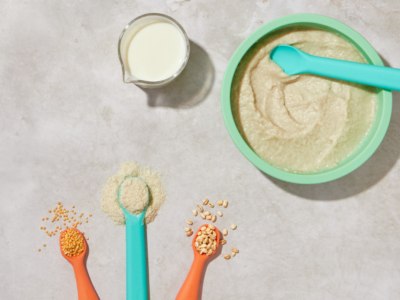
I recommend introducing each of the top 8 allergens (dairy, egg, soy, peanut, tree nuts, wheat, fish, and shellfish) early (so shortly after starting your baby on solids). For these foods, I also recommend testing each for 3 days. For example, if I was introducing egg:
- Day 1: I would offer a small amount of egg to my child. Then I would closely observe and monitor my child for reactions.
- On Day 2: I would offer a slightly larger amount of egg and then monitor for reactions.
- On Day 3: I would increase the amount of egg offered again to a “normal” serving size for your child and monitor for reactions.
There are no official guidelines on what amount to offer each day. Cycling through each of the allergen categories and testing/monitoring for 3 days is a safe and conservative way to introduce allergens. But of course, discussing allergy introduction with your pediatrician for your specific child and having a plan in place on what to do in case of a reaction is always something I recommend.
I’ve introduced allergens, now what?
Introducing allergens is a great first step, but consistency in offering these foods is what’s going to make the biggest difference in training your baby’s immune system. It’s great and recommended to introduce allergens early, but if you do not regularly feed them to your child after that, the benefits of early introduction will be lost. The continuous exposure to these foods is what helps the immune system recognize them, and therefore reduces the risk of a future allergy. With the rates of pediatric allergies rising in the past decade, it’s encouraging that we can make a positive impact on our children by doing this. Additionally, studies have shown that increased diet diversity is associated with a lower risk of developing food allergies[10], while decreased diet diversity is associated with an increased risk of food allergies, asthma, and nasal allergies[11]. Therefore, a varied diet is not only beneficial in terms of nutrition, but it also helps in the allergy department!
5 key takeaways:
- The top 8 allergens are dairy, egg, soy, peanut, tree nuts, wheat, fish, and shellfish.
- Signs of an allergic reaction include hives, welts, swelling, vomiting, diarrhea, and/or difficulty breathing.
- Feeding your baby allergenic foods early (right after starting solids) actually helps to reduces the risk of developing a food allergy later on.
- I recommend introducing allergens over 3 days and monitoring for reactions.
- After successful allergen introduction, continue feeding these foods to your baby.
[1] https://pedsinreview.aappublications.org/content/41/8/403
[2] https://www.cdc.gov/healthyschools/foodallergies/index.htm
[3] https://www.cdc.gov/healthyschools/foodallergies/index.htm
[4] https://www.sciencedaily.com/releases/2018/07/180712100549.htm
[5] https://jamanetwork.com/journals/jama/fullarticle/2553447
[6] https://aacijournal.biomedcentral.com/articles/10.1186/s13223-018-0286-1
[7] https://www.nejm.org/doi/full/10.1056/NEJMoa1514210
[8] https://www.ncbi.nlm.nih.gov/pmc/articles/PMC4416404/
[9] https://www.thelancet.com/journals/lancet/article/PIIS0140-6736(16)31418-0/fulltext
[10] https://www.jaci-inpractice.org/article/S2213-2198(20)30069-6/fulltext
[11] https://pubmed.ncbi.nlm.nih.gov/24508301/